EXPERT INTERVIEWS
Celia Cerqueira
“With such a high volume of candidates, we’ve hit a bottleneck that AI could definitely solve.”
People Manager · Valeria HR
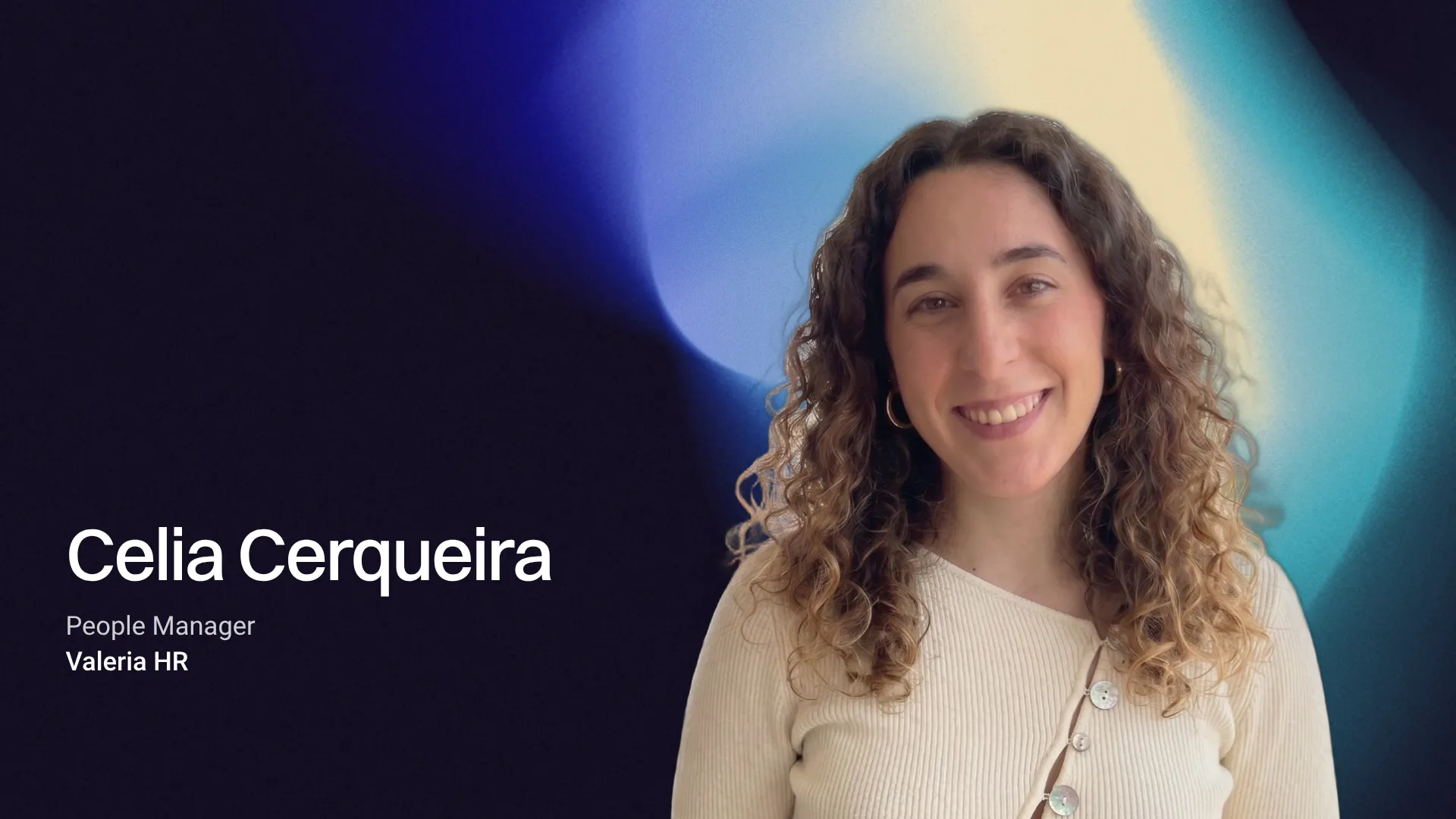
What if AI didn't take work away from you, but gave you back time for people? Celia Cerqueira, People Manager at Valeria HR, talks about choosing AI tools with judgment, building your own People tooling, and protecting candidate experience when you're hiring at full speed.
With new AI tools coming out every week, how do you decide which ones are worth a People team's time?
I think the most important thing is to understand what problem you have and what you want to solve. Right now there's far too much input when it comes to tooling and, if we tried everything that comes onto the market, we'd be choosing tools forever. In the end, by wanting them all, you lose control of the department and don't solve your problem.
You need to be clear about your priorities. If the problem is in hiring: where in the funnel am I struggling, and which tools can help me? If it's in forecasting, the same. Or in talent retention, or performance. I actually work this way myself, because otherwise it would be completely impossible.
You say AI doesn't do our job, it gives us back time for people. What do you spend that recovered time on?
For me, AI plays a fundamental role, especially this past year, which is when we've seen it grow the most. There are admin tasks I no longer do because I have a skill, mainly in Claude, that works for me or with me.
I spend the time it gives back on being with the team. Grabbing a coffee with them, sitting down every week with leads and managers to see how their teams are doing and keep a finger on the pulse, having quality conversations. And also on building the more strategic side of my role, like preparing our company's first career progression framework. I think that's where HR struggles most, because we never have time to sit down and do it.
You built your own onboarding platform with AI. What changes in a new hire's experience when the admin side disappears?
Having our own internal onboarding tooling makes ramp-up much faster and easier. When someone joins, they have a tool where we've systematized everything. There's the more general part, with calendars, mini tasks and even games to make their first two weeks more dynamic, with company-wide tasks but also tasks for their department and role. And there are all the knowledge sources for their team and the company, centralized in one place. There's no dead time.
On top of that, with Valeria, all the admin side of onboarding, like the contract or social security registration, is covered too. So all I have to do is keep every stakeholder up to date, in this case the managers, keep meetings under control, and make sure people have their materials on day one.
If you were starting from scratch today, which part of the hiring process would you improve first with AI?
Without a doubt, pre-screening: reviewing CVs and making that first contact with candidates. It's where I spend the most time and, although it's key, it really limits me operationally. Depending on the role, you can get 200 or 300 applications when there are only one or two people in the department, and every one of those candidates deserves the same care. There comes a point where it's impossible, because then you have to contact everyone and run those first screenings to get to the first interview.
With the growth we've had over these months, this is where we've hit a bottleneck that AI could definitely solve.
You argue that the People field needs to talk more about tooling. What technical skill should every HR professional learn today?
I see two keys. The first is data. When you're part of the business, every decision has to be backed by enough data to bring it to the table. The second is the basics of AI. And I don't mean bouncing ideas around with GPT or Claude, but having the minimum skills to build things: automations, workflows, small tools.
It sounds very general, but it's essential. AI isn't just changing how each department works, it's changing teams themselves: we don't hire the same way, we don't build teams the same way, and we don't work the same way. We need to keep up for two reasons. First, because it will affect how we help managers build their teams. And second, because we're going to need it in our day-to-day work; otherwise, we'll fall by the wayside.
We're a field where everything is still done manually, like years ago, and that has to change. We need to solve our own pain points and turn the function back into what it was always meant to be: supporting our teams in their development and growth.
What risks do you see in People teams building their own AI tools?
Mainly security. Right now, all of us in HR are building our own tooling, but there are a few things you need to be clear about. At Valeria I'm lucky to have an AI team that helps us with this, but you often see people building things without even minimal GDPR compliance or care for data.
Our tools hold quite a lot of sensitive data, including about employees' personal lives, and you need to know how to handle and protect it. That's why, once we start building tooling and getting into code, we need support from the Tech or AI team and to check the security of the platforms we create.
You've lived through very fast growth, from a small team to dozens of people in under a year. How do you protect your employer brand when you're hiring at that pace?
Looking after your employer brand is really hard; it's a challenge we have right now. Marketing and People work together to build it, but we've grown so fast that our employer brand didn't really exist: we're building it as we go.
For me, the key, even without a fully developed brand, is taking care of the candidate experience. We all make mistakes and, when hiring volume is high, especially when you're the only HR person, some feedback or a conversation slips through the cracks. But I try to move quickly between stages and give personalized, continuous feedback. The goal is that even if I tell someone they're not moving forward, they leave with such a good impression that they'd refer someone to you. When you're building something from scratch, starting there is an absolute win.
You just opened a new office, and you say what you love most is giving the team a place to create and grow. How much does physical space matter for the employee experience?
Physical space is fundamental, especially in the hybrid era. At home you probably have your setup just the way you like it, but the office is exactly where we build relationships, work as a team and have lots of valuable conversations. I'm not saying that doesn't happen at home, but here it happens naturally.
That's why having a bright space, with what we need to meet, to have some quiet, to host small events and to enjoy time with colleagues, is key for people to feel comfortable and cared for.
You've said data lets you have evidence-based conversations instead of gut-feeling ones. Which hiring or candidate experience metric should every startup track?
For me there are two big ones, and we're actually just starting to track them, because with this growth, the way we hire at Valeria started to take shape. The first is the conversion rate from application to hire: from when someone enters your funnel until you make the offer and fill the role. The second is the average time between stages, which is also very important. We try never to go more than 24 to 48 hours without following up.
But there's one I think isn't measured much and that, for me, is the mother of all metrics: the hiring process NPS. Just as you'd ask a customer whether they'd recommend your product, I do the same with my hiring processes. It's what tells me where I can improve.
You supported a team, from the People side, through a startup's integration into a much larger group. What did you learn from guiding people through that change?
In my previous role, we went through an acquisition by a multinational that operated globally, and it was a shock. We came from a more startup culture, faster and with fewer processes, and within months we were in the complete opposite. The hardest part was supporting each person through the process. There was a lot of help for everyone to fit into their new teams, but above all it was about the process: "hey, you don't ask for things this way anymore, you have to send a formal email…"
Above all, I learned to be flexible. To understand that an organization needs different things depending on its size, just like the teams within it, and to adapt so you can build what they need at each moment. The work we did, not just from People but across the whole management layer, was essential for that integration to work perfectly today.
Bonus: Finally, on a more personal note: of all the tools you've built, which one are you proudest of?
The onboarding platform. First, out of affection, because it was the first one I built from zero to one. And because when you talk to new joiners and see the impact it has, you can see it's truly useful. I've also built a Performance Review platform and a People Hub with metrics, hiring plan and forecast, but the onboarding one will always be my favorite, even though I'll build many more over Valeria's lifetime. 😊
Next up: Who would you nominate for the next Expert Interview, and why?
Marcos Morea, Head of People at Murphy AI.