EXPERT INTERVIEWS
Daniela Duque
“AI has made all CVs look alike. My job is to find what sets them apart.”
Senior Talent Acquisition Specialist · Amenitiz
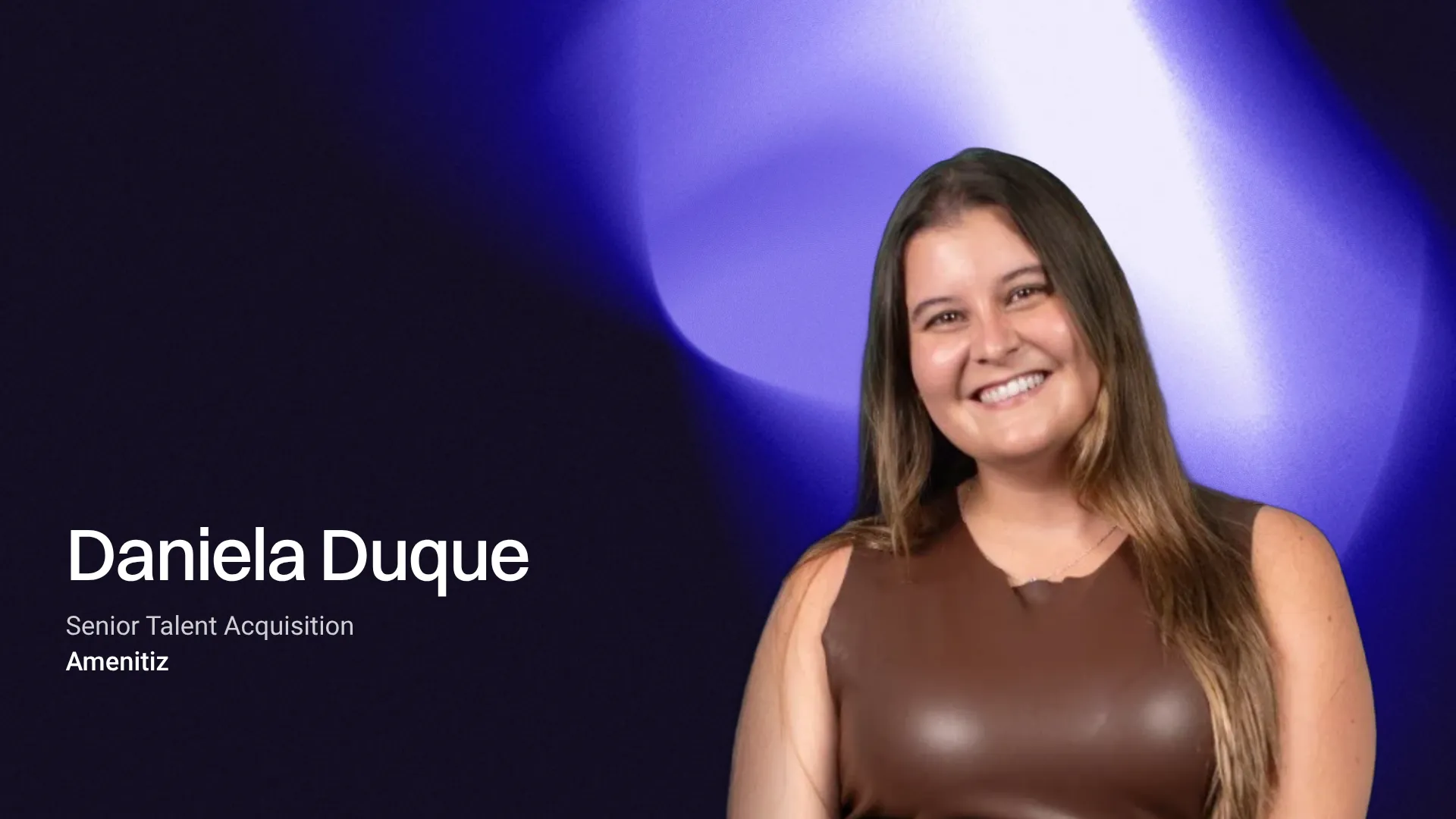
If AI makes every CV look the same, how do you find the person who truly fits? Daniela Duque, Senior Talent Acquisition Specialist, talks about the future of the TA role, how to protect candidate experience at high volume, and what to look for in the first hires of a new market.
With AI, any candidate can have a perfect CV and cover letter. How do you spot who's genuinely the right fit today?
I stopped reading the CV as proof and started using it as a starting point. Today a CV can be written by AI, but personality and fit with a company's culture can't be generated with a prompt. That only shows up in the conversation: how someone thinks out loud, how they react when I push a little, whether they have concrete examples with numbers or just go around in circles.
That's why I give less and less weight to the technical side. If the person has a solid foundation, the technical part can be learned. What doesn't change is how they think: whether they're strategic, whether they understand the why behind what they do or just execute. In sales profiles, for example, I pay close attention to whether the person comes in asking questions or comes in selling. Someone who does discovery before pitching has an instinct you can't teach. And one more very simple thing: did they research the company? With all the tools available today, not doing it says a lot.
In the end, AI has made all CVs look alike. My job is to find what sets them apart.
Five years from now, which part of a Talent Acquisition professional's job do you think will be unrecognizable?
Everything operational: screening, scheduling, writing notes, drafting the first version of a job post. That's already changing today, and in five years nobody will do it by hand. But what will be truly unrecognizable is the role itself. TA will stop being measured by how many positions it closes and start being measured by the business impact of those hires.
Knowing how many people you hired matters much less than knowing how many are still there after 90 days performing well, and why. When I built a Quality of Hire framework from scratch, with checkpoints at 30, 60 and 90 days, it completely changed the conversation with hiring managers and leadership. We stopped giving opinions about candidates and started making decisions with data: which profiles work in each team, where we're failing and what needs to change in the process. In my case, that translated into going from 20% to 75% of hires rated as a "strong hire" in a single quarter.
The TA of the future will sit at the table where the company's growth is decided, not at the end of the chain waiting to be handed a vacancy. It will be half business advisor, half analyst. And whoever doesn't make that leap will be replaced by the same AI that saves them time today.
You've hired for several countries and languages at the same time. How do you maintain a good candidate experience with so much volume?
For me, candidate experience is non-negotiable. And I say that knowing how hard it is to sustain. In hypergrowth companies, it's common for a single TA person to run more than 60 interviews a week and review more than 200 CVs. With that volume, the first thing to be sacrificed is care: replies that take weeks, or generic feedback. And the worst thing that can happen to a candidate is silence. Hearing nothing after dedicating your time, your energy and your expectations to a process is something I find unjustifiable.
If you add several markets, languages and cultures at once, the challenge multiplies, because what feels warm in Spain can feel too informal in France, and what's direct in Portugal can sound cold in Italy.
The only way I've found to keep it from breaking is to have very structured processes behind the scenes so the human side can be personal up front. Mandatory scorecards (we went from 60% to 100% usage), clear interview scripts and consistent notes. And here AI has become a great ally: I work with prompts where I define my own criteria for communicating with candidates (tone, level of detail, what never to say), and from them I create templates that are still human and personalized. It's not about automating the relationship, but about using AI so that, even with 200 candidates in a week, each person receives a thoughtful, timely reply adapted to their conversation and their language.
I have one rule: no generic rejection emails, and never the classic "with more experience you'll find your place." A "no" should arrive with the same care as a "yes." If someone gave you their time, they deserve a considered answer. Because every candidate who goes through your process walks away with an opinion of your company, and they're going to share it, whether you hire them or not.
Candidate experience doesn't end when the contract is signed. What needs to happen in the first few weeks for a new hire to confirm they made the right decision?
That what you promised them during the process turns out to be true. That's the foundation. Then, that they don't have to fight with logistics: if someone is relocating to another country, for example, it helps enormously to have a welcome kit with accommodation, contacts and the practical stuff sorted. And finally, that someone genuinely asks them how it's going.
That's why we launched "Meet your Recruiter": a space in the first few weeks where the person sits down again with whoever hired them, to close the loop, see whether what they found matches what they expected and spot any friction before it grows. On top of that come our 30, 60 and 90-day checkpoints, where we ask both the manager and the new hire, because sometimes each tells a different story, and that's where problems get caught in time.
For me, every hire is a brand ambassador. They're the ones who represent the company in front of our clients, who talk about us outside the office and who, if they have a good experience, bring us the next top candidates. And if they grow within the company, the impact they generate is huge. That's why follow-up can't end at onboarding: it has to accompany their entire employee journey.
That, for me, is what distinguishes a great Talent Acquisition Partner from a recruiter who just fills vacancies. One closes positions. The other is a business partner who builds teams that stay, grow and help the company grow.
What should a startup share in its job posts that it almost never does?
In the startups I've worked at, there's been a lot of transparency about the reality and the expectations. It's normal that not everything appears in a job post: a job post is public, competitors read it too, and it makes no sense to show your cards there about what the company is going to do. But just because something isn't written down doesn't mean it isn't shared. The team's challenges, new strategies, the pace and the way of working are discussed and assessed throughout the whole process, because what goes unsaid can end up being a deal breaker.
What I would add to more job posts are simple things that don't reveal anything sensitive: how success in the role is measured, what the team is like and what the hiring process looks like (stages, with whom and how long it takes). That helps candidates decide whether they see themselves there before applying. The strategic stuff is discussed face to face.
In your job posts you speak very clearly, without beating around the bush. Why does being so direct attract better candidates?
Because it's not about writing a job post for the sake of it, or just making it sound appealing. The goal of a job post is to find the perfect mix of attraction and honesty, in a way that raises the quality of who applies. To do that, we did the groundwork first: building our EVP (Employee Value Proposition) and identifying the company's real ideal candidate profile (ICP), meaning who actually succeeds in each team and who doesn't. We know what we're looking for and what we're not, and that's what filters.
A vague job post attracts everyone and convinces no one. When you're clear about what you expect from the role and who it's made for, you can say it plainly, and the person who applies already arrives aligned. And when a candidate reads a job post and thinks "this is for me," the chances of them being a good hire are much higher than when they apply to everything they see. Plus, the tone of the job post is the first glimpse of the culture: if you write the way you talk in the office, the candidate knows from minute one who they're going to meet. And the best profiles, who usually have options, really appreciate it when you don't waste their time.
You've worked in teams with dozens of nationalities. How do you assess cultural fit without always ending up hiring similar profiles?
The problem appears when cultural fit is assessed by affinity rather than by criteria. So the first thing is to define what we're measuring. For me there are two layers: experience, which is where we want diversity of backgrounds, markets and ways of thinking, and professional DNA, which is what needs to be aligned with the company and the role. Two people can have the same experience and a completely different DNA: how they make decisions, how they handle pressure, how they respond to feedback. That's where fit lies.
The second thing is that those criteria shouldn't come from intuition. In our case, we built them from data: we analyzed what the hires that worked in each team had in common, and the ones that didn't, and with that we defined a hiring bar per role. Then we assess it with structured questions, criteria agreed before the interview and scorecards that require every decision to be justified with evidence.
The result is that we don't hire the same profile over and over, but very different people who share what's essential. That's culture add: someone aligned with the values who brings what the team doesn't have yet. And in teams with so many nationalities you see it very clearly: the way people communicate changes from culture to culture, but the DNA that fits a company can be recognized in any language.
You've built teams from scratch in new markets. What do you look for in those first people that you wouldn't look for in number fifty?
The reality of opening a new market is less glamorous than it looks. When we opened the first office in Lisbon, those first people had no local team, no processes adapted to the market and no recognized brand to open doors for them. They didn't have anyone to ask in the hallway either. Everything that worked in Spain had to be validated again in Portugal.
That's why, in those first profiles, I look for three things that wouldn't be a priority for person number fifty. First, real tolerance for ambiguity: people who don't wait for instructions and who know how to make decisions with incomplete information. Second, a builder mindset: someone who doesn't just execute, but defines how things are done and documents what they learn for whoever comes next. And third, deep knowledge of the market from the inside. Native language is non-negotiable, but it isn't enough either: you need someone who understands how the local customer buys, decides and builds relationships.
On top of that, from the hiring side there's another reality: you can't sell a brand that nobody in that market knows yet. What you're selling is the project, the opportunity to build something from the very beginning. And that attracts a very specific type of profile. The first hires carry disproportionate weight: they set the culture of the local team, define the processes and are the ones who attract the next people. A mistake in hire number fifty can be fixed; in hire number one, it shapes everything that comes after. Person number fifty needs to execute well within a system. The first ones have to create it.
You've worked both at a recruitment firm and inside a startup. What did you take from one side that you apply on the other today?
[...] hiring for positions you know practically nothing about at first. There's no choice but to dive in, understand the role, the business and the market, and become an expert in a very short time so you can ask the right questions and assess each candidate well. On top of that, working with very different clients taught me to understand different business models, different ways of organizing processes and different communication styles, and to adapt to each one without losing rigor.
Inside a startup I learned exactly what you don't see at an agency: what happens after the contract is signed. When you're inside, you live with the outcome of every hire. You see whether the person performs, whether they stay, whether they help the team grow or whether it was a mistake. That forces you to prioritize quality over speed and to build processes that can be measured and improved with data.
Today I apply both at the same time. In a startup, change is constant: new markets, new roles, new strategies, and the adaptability I learned at the agency is what lets me respond quickly. But I do it with the responsibility of someone who knows that every hire will impact the business for years. That combination is what, for me, turns a recruiter into a true business partner.
Bonus: To close, on a more personal note: which hire are you proudest of?
Honestly, it's impossible to pick just one. But if I have to choose, I'd go with a type of hire: the people I took a chance on when their CV didn't tell the whole story. The ones where, during the conversation, I saw something that wasn't written anywhere: a way of thinking, a drive, a DNA that fit even if their experience wasn't "perfect" on paper.
What makes me proudest is seeing them months later: that they stay, that they grow, that they take on more responsibility, and that many end up referring other amazing people to us. That's when you feel your work goes far beyond closing a vacancy. That in some way you helped change someone's career path, and that person is now helping the company grow.
In the end, that's the best quality indicator there is.