EXPERT INTERVIEWS
Ivan Jiménez
“The price of a hire isn’t set by the employer or the candidate: it’s set by the market.”
Co-Founder & Managing Partner · Nuclio Talent
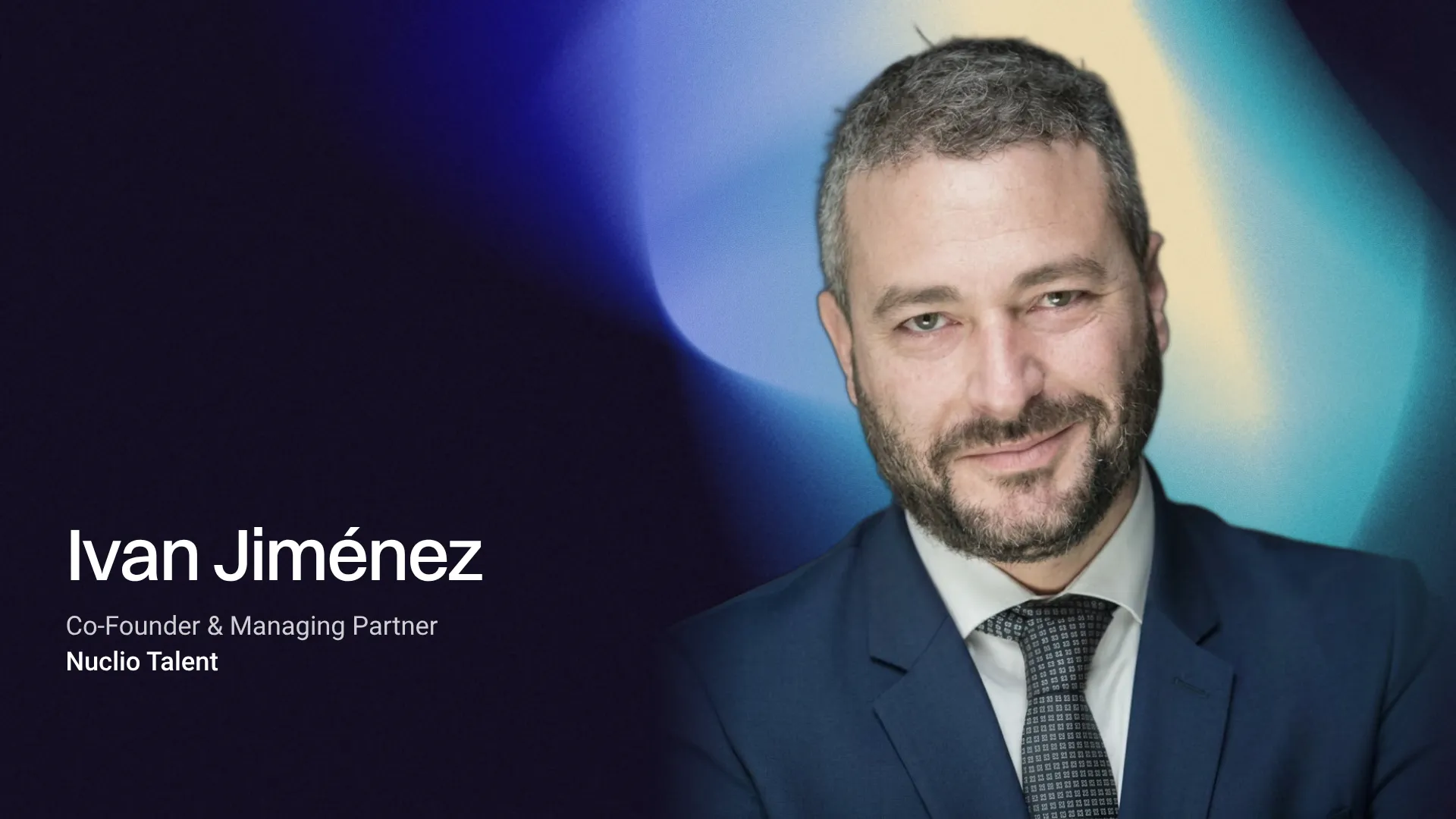
Who really sets the price of a hire? Ivan Jiménez, Co-Founder & Managing Partner at Nuclio Talent, talks about how hard it is to assess AI profiles, salary transparency, and why specialized recruiters find better candidates.
You're increasingly looking for AI profiles: AI engineers, LLMs, agents… What's the hardest thing to assess in someone who works on something so new?
The hardest thing is precisely how new it is. Not so much with technical profiles: many of them were already working with what we used to call machine learning and have evolved towards AI. But with more functional profiles, like the AI manager or whoever has to lead the transformation or implementation of AI in a company's processes, the lack of experience in the market is a handicap. Finding people with a lot of training or experience is very difficult, practically impossible. That said, the situation improves every day, because people are getting more training.
And on the other hand, there's the speed of change. In the last year and a half, the tools have evolved enormously, there's been an explosion of AI, and it's starting to be hard to keep up with what's happening.
If you were starting a recruitment firm from scratch today, what would you do differently thanks to AI?
If I were starting a recruitment firm from scratch today, I'd automate all the administrative tasks, which is something I've had to suffer through. This job carries a very heavy administrative load. We have two main functions: business development, which is winning new clients and getting them to outsource their hiring processes, and recruitment, which is finding and selecting profiles for those clients. Both generate a lot of admin work: in business development, all the prospecting, and in recruitment, the activity reporting.
Above all, I'd automate the executive summaries of interviews and the reporting on candidate assessments. Today that can already be automated and turned into very specific, concrete executive summaries that ease your administrative load, which is what we like least and what adds the least value to our work.
A top candidate gets several messages from headhunters every week. What makes them reply to yours?
I ask myself that a lot. Some people think it has to do with age, with assuming that if you're older you handle higher-value searches and, therefore, more interesting ones. Others believe it depends on the impact of the message itself: getting the "what's in it for me" across really well and making it appealing, so the candidate is curious to learn more.
But for me, it's still a mystery why some reply and others don't. I suppose it's a combination of variables that, in the end, produces the result.
More and more job posts show the salary range from the start. How does that change a hiring process?
On the candidate's side, a significant share have a high opinion of themselves and, if the employer is willing to pay within a range, they always place themselves at the top of it. From the employer's point of view, there's a tendency to think that hiring the ideal profile at a lower cost is always an advantage. In reality, I don't think either is entirely true.
Hiring a top candidate for an amount that doesn't meet their expectations means they'll keep an eye on the market and stay open to other opportunities. After all, they get loads of messages every week, so why wouldn't they listen to anyone else? And on the candidate's side, always placing yourself at the top of the range creates expectations that can later be frustrated during onboarding, when it becomes clear your level of seniority doesn't match the pay. Then expectations aren't met and the employer may end up thinking they made a mistake.
If you publish a range, it's because you have a budget for that role, and anything outside it exceeds your budget. That range may be based on what you think you should pay or on your company's internal pay equity. But that internal equity may be outdated, because you haven't hired anyone in that department for years and you've updated salaries in line with inflation, not with how the market has moved.
A candidate who's worth 50 is worth 50. One the market pays 80 is worth 80. The price of a hire isn't set by the employer or the candidate: it's set by the market. Trying to hire people below what the market pays is, for me, shooting yourself in the foot. Because a candidate who's good, and knows it, is going to get offers, and all the time you've invested in training them, in getting them to know your company and in helping them give their best can be lost just because a message lands in their inbox offering an amount in line with what the market pays for them. As simple as that.
Many of your job posts don't show the company's name. How do you get a good candidate interested in a project without knowing who's behind it yet?
By trying to convey the strengths of the project. In our case, the client's name is hidden 100% of the time. The first rule is not to lie and not to put anything in the message that isn't true. But every company has strengths, and also areas for improvement.
When you work for a company with a very well-known brand, it's relatively easy. I remember working for one of the biggest sports organizations in this country, with a globally known brand, and I wasn't allowed to tell candidates who was behind the search. But if I wrote to them, "I'm working for a sports organization with global reach, a brand recognized all over the world and offices in Barcelona," they didn't need much more to figure it out.
The real art lies elsewhere. If you work for Google, attracting talent is relatively easy. But if you work for, as I like to say, "Martínez Ironworks," what's so great about Martínez Ironworks? We work with very powerful global companies, but also with industrial boilermaking companies, which isn't very sexy. And in every case you have to convey the project's strengths so that, at the very least, a conversation with the candidate gets started.
I usually reveal the company's name when the client validates the candidate and wants to meet them. Until then, I keep everything confidential, with the risk that the candidate later tells me: "I have a friend who works there and I'm not interested at all." That's why I try to give them hints so that, with a bit of research, they can work out whether it's company A or B. That way, if they've already been through a process with them and were turned down, we don't move forward.
You've led CEO searches for investor-backed startups. What do investors look for in a CEO that never appears in the job description?
Right now I'm handling a CEO role for a startup backed by a team of investors: entrepreneurs who've had other well-known companies and want to launch a new company in an emerging business related to men's health. What are they looking for? Mainly, someone who has walked the path, who has already been CEO of another startup.
Because once you've walked that path, you know what you did right, but also what you did wrong. For them, it's very important to have that learning curve already covered. Why? Because it saves money. In the end, mistakes always end up costing money. And in a startup, with limited resources and the need to reach the next round, that's hugely important.
You also search for technical co-founders for early-stage startups. How do you assess the fit between partners when there's no role, just a project?
When there's already a team in place, the fit between them is almost more important than technical ability. Technical ability is a given. If you're looking for a CTO, you'll assess which tech stack they'll work with, whether they've scaled tech teams and whether they're hands-on or not, because that matters in the early stages.
But what's fundamental is the fit between the partners. There are lots of tools designed to align each person's personality. Tools that, on the other hand, end up being set aside. When you ask them why they chose A over B, between two equally prepared candidates with the same experience and the same ability to move the project forward, people end up relying on something as unscientific as gut feeling.
Your team works by specialty: tech, engineering, finance, digital… Why does a specialized recruiter find better candidates?
Because they learn. Basically, they find better candidates because they learn. Tech is the proof: 99% of the recruiters who do tech recruitment don't have a technical background. They couldn't program or understand three lines of code. But by interviewing lots of candidates, one tells you something, another tells you more… And the curious recruiter, who asks, who reads up, who then goes to Google or ChatGPT and asks, "What's this Java thing? What's Python?", starts to understand what each thing is for and what each tool does, and ends up with a certain technical veneer. That helps.
When I started in recruiting, I was in Sales & Marketing and I specialized early in digital. Then I studied digital marketing and trained out of pure curiosity. At one point I even wondered whether I wanted to keep doing this or move into digital marketing. With middle management and C-level we were already discussing marketing strategy, and that helped me win more clients: those conversations with CMOs led them to trust me with searches for part of their team.
A lot of it has to do with the ability to debate: to challenge their strategy, make them think, understand what they have in mind and empathize with their perspective. For example, with a very large startup in Madrid, the CMO had a crisis of confidence with one of our consultants. We started talking about what was relevant in their strategy, why this profile and not that one, what impact and what level of influence the role would have… And now we're in a honeymoon phase: they've already opened a third position with us, because they understand we're part of their team and we know where they're heading.
What do you look for when you hire a recruiter for your own team?
I still have my doubts. One of my biggest insecurities is whether I get it right with people, and I've had my failures. The first thing I try to do is understand what I already have in-house: to look for people who will add value and fit well with the rest of the team.
But above all, I look for attitude. We hire a lot of people in their first jobs, who are curious about this world and want to give it a try. They have an initial six-month period, as a kind of trainee, which helps us gauge their motivation and helps them see whether they like it. Because people think you post an ad, 10,000 people apply, you filter, you interview, you present someone to the client and that's it. It's much trickier than that. And there's an important business development side, so you need people who enjoy dealing with clients and with people, who have a proactive attitude towards sales and leadership skills: the kind of person who, in their group of friends, is the one who suggests plans and gets everyone going. From there, they need a good pitch, commercial impact and the ability to grow.
For me, this is a craft. Just as a carpenter is a carpenter for life, a headhunter is a headhunter for life, whatever brand they work for. And that's the hardest part, because when you're very young you want to try new things. But above all, I look for attitude, drive to push and learn, and people who enjoy being around people.
What has surprised you most about building a business in the talent world?
I came into this sector relatively late, at almost 40. I'd already been an entrepreneur, I had a small company with a partner, so I already knew the hard side of starting a business. What has surprised me most is the generational change. In the almost 20 years I've been doing this, things have changed a lot.
There are things about younger people that I really admire: their determination, how directly they go after everything and how clearly they see their career and steer it. In my day we were completely lost: as soon as someone gave us a chance, we jumped in. It fascinates me, because it's something I would have liked to have.
On the other hand, there's the paradigm shift from living to work to working to live, and how much they value their time, something we didn't. Today there are people who turn down a job so they don't have to cross Barcelona, when I've known people who lived in Toledo and commuted to Madrid every day. Some things are hard for me. And then there's the smartphone: my generation was all about nobody calling you at work so as not to disturb you, and now you see people scrolling Instagram at work. At first it shocked me; now I'm more used to it.
To close, on a more personal note: what's the hardest search you've ever closed?
I've had several impossible searches. One was to lead the digital department of a large organization, and the benchmark wasn't another similar organization, but Disney: someone who had ideally worked for the Chinese or North American market. And if they were Catalan as well, even better. I found them, and it opened the doors to a very powerful client I worked with very successfully for several years.
The other was for a global fashion brand that had been looking for a product director for two years. But not a fashion product director, an online product director: someone very strategic who could tell them where e-commerce was heading in the coming years and anticipate projects within the company. I found them, and quickly, and that made that company my best client for many years.
Those are the two I'm proudest of, because behind them were big companies, big brands and great professionals who had been trying for years without success. And, humbly, I managed it.
Who would you nominate for the next Expert Interview, and why?
I'd nominate Jorge Santamaría. He's a friend of mine, he was my colleague and later my boss at two companies, and he's the person who brought me into this sector: he's to blame for me being here. He's been in the sector for many years: he started at Michael Page, moved to Hays, where he grew enormously, we worked together at CaixaBank, and then he founded Robert Walters' Barcelona office. He was then regional director at LHH and is now Senior VP at Randstad, where he runs Randstad Professional and Randstad Technology. He's a truly authoritative voice.
I'd also nominate Mario Vázquez, who was my first boss in this world and now works at Hays Executive.