EXPERT INTERVIEWS
Montse Ortega
“The risk isn’t in the AI tool but in how we use it.”
Talent and Culture Manager · Kintai
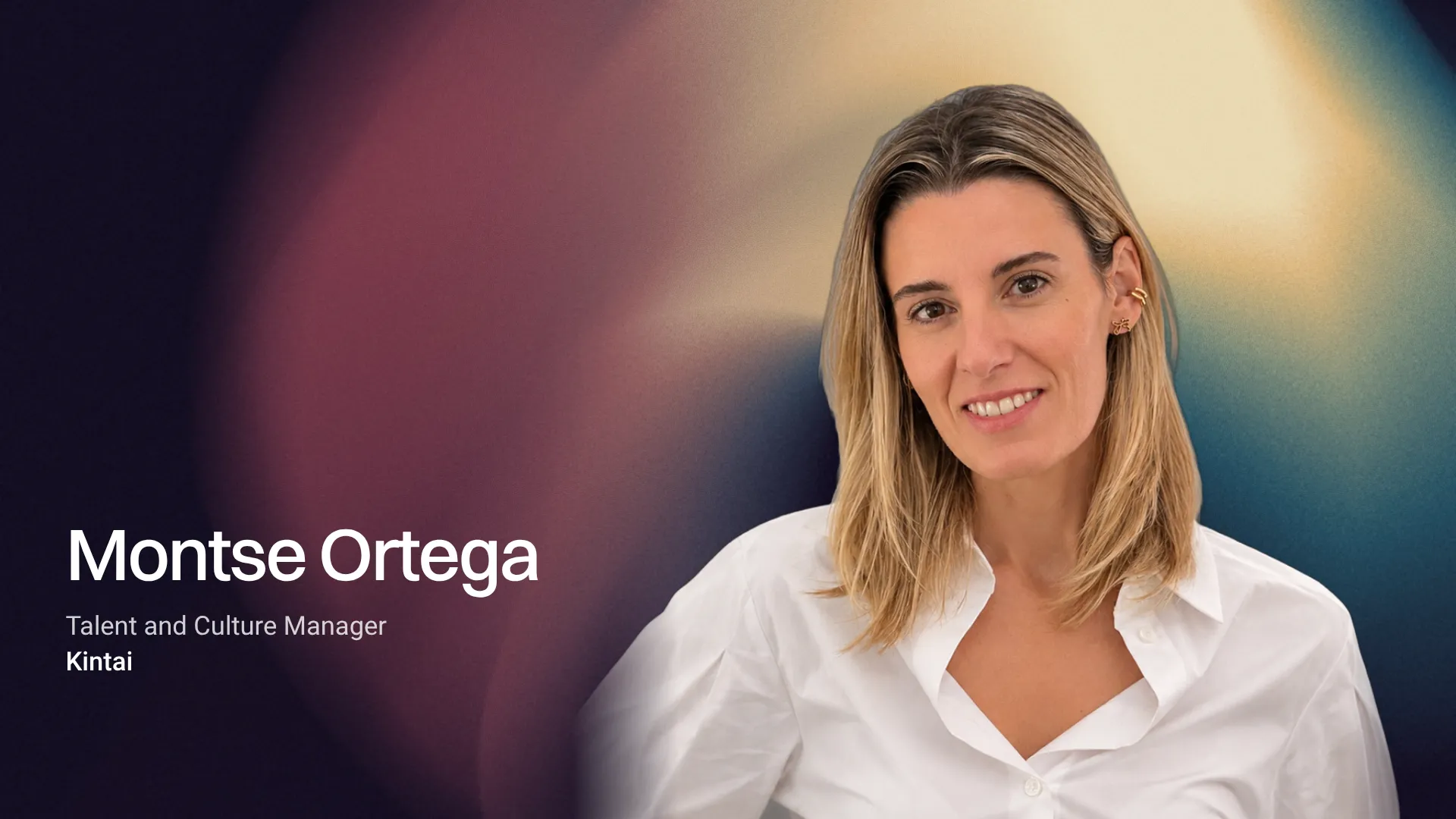
What’s the difference between hiring for values and hiring people who are just like us? Montse Ortega, Talent and Culture Manager, talks about AI as a superpower, the human skills it can’t replace, and how to build more inclusive hiring processes.
In 2024 you asked whether AI in hiring was a technological revolution or a detachment from the person. What's your answer today?
I'd say it's a superpower. We have access to so much more, almost instantly: information, tools, knowledge… but you have to know how to use it and, above all, have the judgment to assess whether what it gives us makes sense in our context.
In hiring, for example, ignoring that judgment can lead to biases and push us to lose the human side. But, as I said, the risk isn't in the tool but in how we use it. If we're looking for diversity but train an agent on the profiles that have worked for us so far, it will give us more of the same, and we'll end up hiring clones.
Tools like Hirevoice add a lot of value: they help us organize and highlight CVs by competencies, schedule interviews, be more precise and respond faster to the people taking part in a process. I say "they help us," because "deciding" (who fits, who brings something new, who shares our values…) is still a conversation between people.
You write that, right now, with technology moving so fast, it's key to develop the skills AI can't reach. What are those skills for you?
For me it's very clear: the ones that play out in the relationships between people. AI can analyze, summarize, suggest… but it can't be present in a difficult conversation or earn a team's trust. I'd highlight five:
Active listening and empathy: Truly listening isn't just paying attention to what the other person says, but to how they say it and what they feel. A tool can transcribe a conversation, but it can't read what lies behind it.
Judgment in context: AI gives answers, but someone has to decide which ones fit the reality of the team, the people involved or the organization's values. The more information we have at hand, the more valuable it is to know what to do with it.
Building trust and psychological safety: Whether someone dares to ask, make mistakes or disagree depends on the culture the team has built, shaped by people's behaviors.
Anticipating and unlearning: Exposing yourself to different ideas, questioning what used to work and letting go of what no longer serves. Technology changes fast, and what makes the difference is our ability to adapt.
AI should take mechanical work off our plate so we have more time and headspace for these skills.
In your article "Values interviews, not personality interviews," you warn that hiring for a similar style can pass for hiring for values. How do you really assess values in an interview?
The first thing I'd say is to separate the how from the where-from. Personality reflects how someone works: their pace, how they communicate, how they focus… Values are where they work from: what taking ownership means to that person, what they understand by a job well done, when they ask for help… When we're not aware of this difference, we end up rejecting someone just for not being "like the rest of the team." That's similarity bias.
In my case, what helps me most is asking about real situations. I ask for concrete examples and pay attention to the content of what the person tells me, not how well or how quickly they tell it. I also rely on tools like scorecards with behavioral anchors, which define the specific behaviors that represent each value I want to measure. That way, the decision rests on real behaviors that reflect our values, not on the first impression the person gives us.
This year you've been looking for books on neurodiversity to design more mindful workplaces. What would you change first in a hiring process to make it more inclusive?
I'd change the format. Many hiring dynamics (improvised interviews, timed technical tests…) measure social fluency or speed under pressure, not the ability to do the job. Most processes are designed for a fast, verbal, sociable profile... and with that filter, the person who needs a few seconds to think, the one who's more introverted, or the one who looks away while organizing their ideas, loses out.
I'd also review the evaluation criteria so they measure what the role really needs. And, connected to what I mentioned before, the question I'd like every team to ask is: "What does this person bring that we don't have yet?"
You write that nobody decides to create silos: they appear on their own while we grow. What should the People team at a 20-person startup start doing to prevent them?
Start now, even if it seems early. With 20 people, habits are still forming and you can decide how you want to work instead of correcting how people already work (which is the hardest part).
You don't need to build the structure of a 100-person company. What I would do is start defining how we want to be when we're 50:
Set communication agreements: which channel is used for what, what gets shared and how.
Share goals across teams.
Create rituals like cross-team reviews or open demos.
Train managers to act as bridges.
Take care of onboarding, so every person understands how they fit with everyone else and why things are the way they are.
And above all, be consistent.
You describe yourself as a "People, Values & Culture fanatic." What got you hooked on company culture?
What hooked me was realizing how much weight culture can have on people. I've seen teams with incredible values but practices that said the opposite, and teams that never talked about culture but lived it every day. That gap between what we say and what we do is what I'm passionate about: how someone new is welcomed, how feedback is given, how decisions are made. Small things that often aren't measured or taken into account, but that, added up, are what ultimately decide whether people want to stay.
To close, on a more personal note: which book has made you rethink how you work with people?
I'd recommend Radical Candor, by Kim Scott. I know it's a classic, but I think it's a book worth reading. It has shaped me in many ways and I've incorporated quite a few of its ideas into the way I communicate.
What stayed with me most is how simple the approach is and how hard it is to apply. The concept is talked about a lot, yet we're far from reflecting it. We still don't really understand what feedback is, what it isn't, how we should give it… Many teams say they value feedback, but in practice it gets delayed, softened until it says nothing, or only shows up when something has already gone wrong.
For me, beyond being a technique for giving feedback, Kim Scott's concept forces me to ask myself how many conversations I'm avoiding out of comfort and what signals I'm sending about what's safe to say in my team.
Who would you nominate for the next Expert Interview, and why?
I'd nominate Cristina Rallo, co-founder of Merlín Digital. I've trusted her and her team for years whenever I need support finding key profiles. They've built a consulting style that's very focused on the person, values and culture, without forgetting the technical side. Plus, I'm sure she'd be delighted to take part!