EXPERT INTERVIEWS
Oriol Vila
“When you grow fast, every hire either adds to the culture or dilutes it.”
Co-founder · BlaBlaNote | Co-founder & former CEO · Holaluz
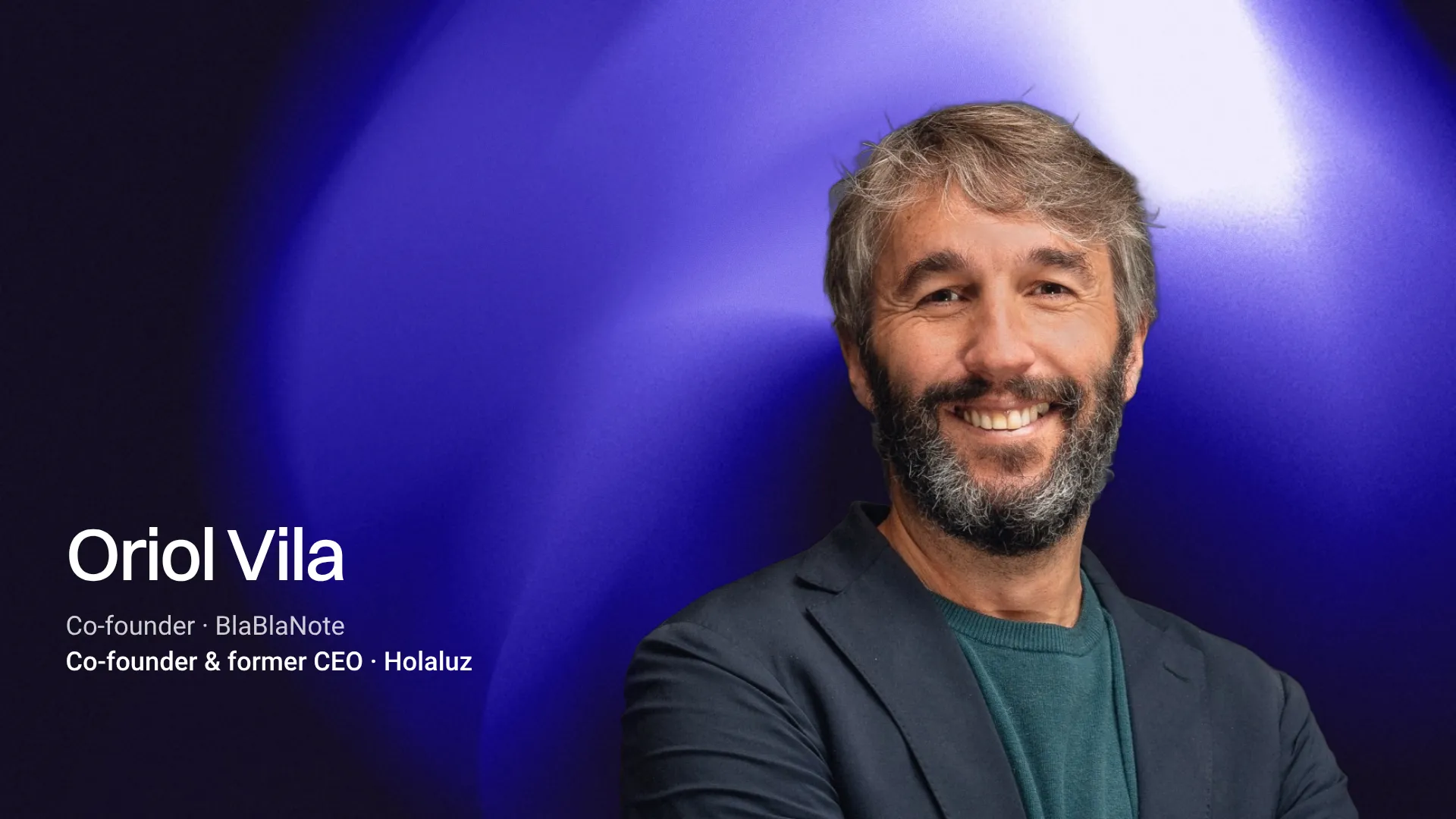
How do you protect culture when a company is growing at full speed? Oriol Vila, co-founder of BlaBlaNote and co-founder and former CEO of Holaluz, talks about helping teams lose their fear of AI, the compounding effect of well-chosen talent, and building companies where mistakes aren’t scary.
You say AI is here to stay and that now is the time to act so we don't have to worry later. What should a company do today to help its teams lose their fear of it?
Training, support and sharing examples. There are two ways of thinking about AI (I didn't come up with them). One says that with AI I'll need fewer people, so I'll do the same with a smaller team. The other says I have a team that knows the business and the culture, that I trust and that has already proven its worth, so I'll give them a tool that multiplies their capabilities to achieve much more. I'm clearly betting on the second.
To do that, you need to identify the people who have the most affinity with these topics and the least fear, hold them up as examples and have them work with the other teams to reach milestones that seemed impossible just one or two years ago. It will be gradual: we'll probably start with productivity, but it has to reach the core of the business to transform it. Companies that put this capability in their teams' hands will be in a privileged position compared to those that don't dare.
You took Holaluz from its early days to the stock market. What did you learn about protecting culture while the company was growing so fast?
First, that you have to devote an enormous amount of time to it. Culture is something very deep, and until you live it firsthand it's hard to understand and internalize. You protect it, above all, by example. Also by putting it in writing, so it doesn't depend on each person's interpretation, and by making a big communication effort. And finally, by making sure that every person who joins fits with it. For me, cultural fit is an essential stage of the hiring process: when you grow fast, every hire either adds to the culture or dilutes it.
Your motto is "Relationships compound. Contacts don't." How can companies apply that idea to attract and retain talent?
They say one bad apple spoils the whole barrel. The opposite is also true: people with a strong cultural fit and influence over the team multiply the effect of that culture. Just like relationships, well-chosen talent has a compounding effect. That's why you have to choose very carefully who makes up the team and take care of how the culture is passed from one person to another. If you get it right, it scales and multiplies, and it also becomes the best way to attract other people who share that way of doing things.
You're very interested in the impact economy. How much does purpose weigh today when someone chooses where to work?
I'll practice what I preach. I created BlaBlaNote after a period of reflection, and I did it mainly because I truly believe in what I do: working to nurture and strengthen human relationships. Working for that purpose multiplies my excitement, my drive and my strength. It helps me in the bad moments, not to mention the good ones. I experienced it at Holaluz too, and I'm convinced it helps any company attract the best talent and generate a unique energy, capable of breaking barriers and reaching any milestone it sets.
You advocate for talking more about mistakes. How do you build a company where getting things wrong isn't scary?
By leading by example and not penalizing mistakes. When someone gets something wrong, you can't judge or criminalize them. But you shouldn't be paternalistic either: you need to spread a culture where mistakes are corrected quickly and, above all, not repeated. When the rules are clear, people dare to try things and make decisions, and that's what moves a company forward. And by the way, it's worth focusing on over-communicating the wins, to make up for the mistakes, which communicate themselves…
You advocate for conscious networking, with method and without a purely transactional interest. What advice would you give someone who wants to build their professional network from scratch?
Method and awareness. We can't give something we consider important only the time we have left over. If you believe building a network will make you better personally and professionally, and I have no doubt that it will, set aside a few hours for it every week. First, define your goals, which will change over time. Then look for the people who are already in your network, who give you energy and with whom you want to share it, and reconnect to strengthen that relationship. Next, go to events that fit your goals to meet new people. And a format I really like is forums, understood as groups of people at similar personal and professional moments who meet regularly and share their situation. That regularity builds a lot of trust and adds enormous value. Oh, and use BlaBlaNote ;)
To close, on a more personal note: who do you owe the most to in your career?
It's not just one person. It's something I reflected on recently: I have a group of friends, most of them from university (I'm an industrial engineer), and we're a healthy group of good, decent people. Since then we've supported each other, often without realizing it, and I think a good part of where many of us have got to is thanks to that. I like to think it has had a big influence on who I am today. And since I see myself above all as an entrepreneur and an engineer, it makes sense that the people I owe the most to are my engineering classmates.
Who would you nominate for the next Expert Interview, and why?
I'd nominate two people. The first is Josep Maria Montserrat, a friend from university who has been at Grupo Agbar for 25 years. He truly believes in the project he works on and in people, and he really takes care of them and helps them grow in a corporate environment, where that isn't always easy. I greatly admire how he approaches and handles those challenges.
The second is David Tomás, a true benchmark in corporate culture. He has won Great Place to Work several times, built a company around people, and known how to give his team space and reinvent himself when needed. I've learned an enormous amount from him.