EXPERT INTERVIEWS
Xavier Oliver
“I think AI has given a second chance to senior profiles.”
Co-founder and Head of Recruitment · talent wins
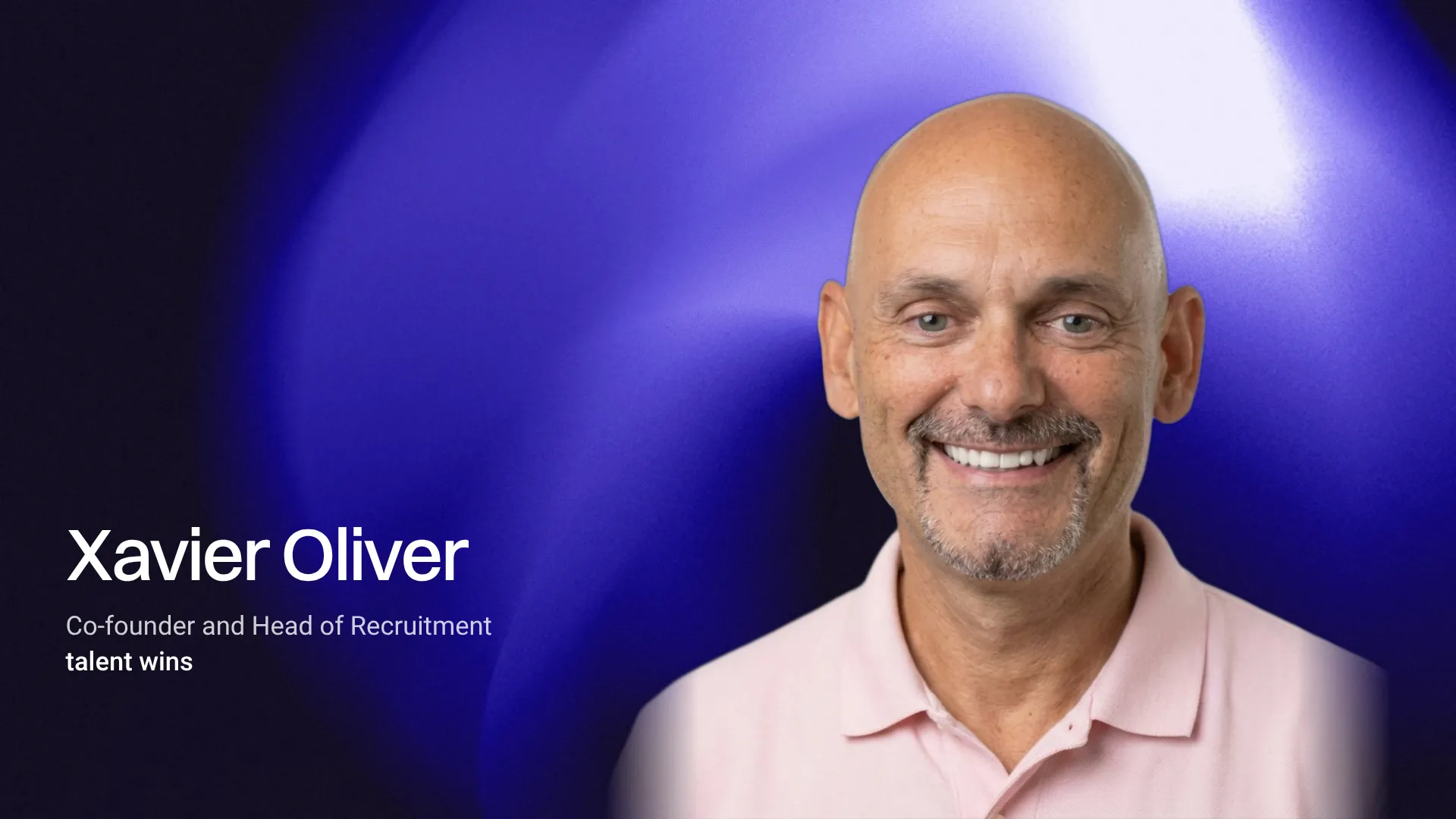
“They didn’t fit.” With what, exactly? Xavier Oliver, Co-founder and Head of Recruitment at talent wins, talks about what AI still can’t see in a CV, why you need to know the manager before the candidate, and the value of senior talent in the age of AI.
A few months ago you brought recruiters together to debate whether AI means their extinction or their evolution. What was your takeaway from that debate?
The takeaway is that AI helps us in the early stage of qualifying, assessing and approaching candidates. But then we need to step in in a “human” way, so to speak, to apply what I call natural or emotional intelligence: spotting things like motivation, drive and a perfect fit with what the client is looking for. I don’t think that can be achieved through automation, at least not so far.
You say that what makes a hire last is almost never on paper. Which part of what doesn’t show up on a CV can AI help uncover?
A CV gives you someone’s work history in 2D, as I call it, and you need to dig deeper to get a third, fourth or fifth dimension of the candidate. Beyond what’s written, you have to interpret, use your intuition and build a full profile that gives you the information you need to decide whether this is the right person for the role.
Can AI do that? It’s moving very fast and I don’t know what the future holds. But today I think human input is still needed to qualify the person better and understand the company’s culture, what the managers are like, how they’ll fit with the team and with the moment the project we’re offering is going through. That’s what gives you the ideal match with the perfect person.
When someone on a hiring committee says “they didn’t fit,” you always ask: fit with what? What’s the answer you hear most often?
What often happens in companies is that they want everyone to like the same color, dress the same way, be “cut from the same cloth,” so to speak; in other words, to blend into the herd. And when you look for someone who really adds value, who’s disruptive, who brings fresh air, innovation and growth, and who thinks outside the box, it’s often scary. It’s scary because you don’t know how to manage a profile like that, you think they might unsettle the rest of the team, that they might ask uncomfortable questions.
But I believe that what matters, both professionally and personally, is asking yourself uncomfortable questions. The problem is that years go by without us asking them, without doing a kind of internal check on how we want the company or the project to be. And we ourselves, as executives, as professionals and as people, also need to stop every now and then and ask ourselves those questions.
I see it clearly in many leadership committees and companies with a board: when someone isn’t cut from the same cloth, they get sidelined. Sometimes it’s not so much firing them as leaving them in a corner until they get tired, burn out on the project and feel like they’re rowing against the tide. And that’s what eventually makes people decide to leave. When you don’t fit somewhere, you can tell, and what bothers people most is realizing they’re not aligned with the people they should be aligned with.
You say that before looking for a candidate, you need to get to know the manager they’ll report to. What do you ask that manager?
Above all, what they really expect from this person, how far they want them to go and how far they’ll let them go. It’s a cliché, but if you have a good team, it’ll make you better. And yet it often isn’t applied. Some managers are afraid the person they hire will take their job or show them up. It happens a lot in large organizations with a strong political culture, where there’s more politics than work, and you can spot it quickly. People who are truly focused on the project and get things done leave when they see their manager isn’t up to the job.
That’s why it’s so important for me to understand what kind of person the manager wants: someone who says “yes, sir” all day, or someone who goes further, develops their skills smartly and makes the team, the project or the company better. All of this has to be in the initial brief.
You need to understand those nuances, because often the person you think is ideal doesn’t move forward, and the client tells you: “No, they’re just not going to fit.” When you ask, “What did you see? What didn’t you like?”, you often realize the initial brief wasn’t telling you the whole story. Important nuances were missing. Having all this information first-hand is essential to move quickly in a hiring process and find someone who fits perfectly.
You’ve written that in many companies, the people who get promoted are the ones who always say yes. How do you spot, in an interview, someone who dares to push back?
I like profiles that ask questions, that analyze, that do their homework before the interview and gather information intelligently. In other words, they don’t walk into the interview blank. Today it’s very easy to research a company, its executives or its news; AI helps you with all of that. If you don’t do it, you’re already showing you’re not very interested.
That’s where you notice someone inquisitive: they analyze, ask why, research and ask the right questions. “Who has done well in this project? What hasn’t worked? Where do you want to be in one, two or three years? How can the role evolve? Where do you want to take the company? What’s the strategic plan?” I’m not talking about entry-level or blue-collar roles, but about executive recruitment, C-level or mid-level profiles: there, it’s essential to have someone who asks you these questions.
In fact, when everything in a hiring process feels very easy, that’s when an alarm goes off for me. Maybe we haven’t asked the right questions or pushed the person out of their comfort zone to understand exactly what they want, what they don’t want and who they are. And you need to push both the company and the candidate out of their comfort zone, because both need a real squeeze: “Honestly, what do you want? What do you need? What does this person need to be like?” Sometimes they realize the job description isn’t developed enough.
We live fast and want everything yesterday, but rushing a hiring process can backfire badly. Haste is never good when you’re looking for someone who’ll have an impact on the structure and on the company, which is ultimately what they want.
Before hiring a director, you ask how many of the people who worked with them would follow them again. How do you get an honest answer to that question?
It’s hard, but someone who can really bring a team along is gold, because it means they’re a good leader. And today a good leader amplifies results. Someone can be very competent, but they need to be able to manage a team, inspire it and get the best out of it. If people follow you, you’ve succeeded. The proof is being able to “bring along”, so to speak, the team you’ve built elsewhere. That’s a really good sign that a manager knows how to win people over, lead, inspire and motivate a team.
When there are three finalists left, many companies rule out the most senior one because they’re the most expensive. What do they lose by making that decision?
It’s a broad debate. In hiring processes today we often see the dilemma: “Will someone over 55 give us what we need, or do we prefer someone who’s 30 because they have more energy and more digital skills?” I always ask the client the same question: “What do you really want? Don’t think about age, think about what you need.” We often limit ourselves when looking for the person we need: we define a gender, an age, an education, a location… It may be politically incorrect, but in the end clients tell you: “This type of person has worked better for me.”
And whenever I’ve recommended choosing a senior candidate, it has worked out well. Why? Because they have experience and life experience. Obviously you need to assess their competencies and the skills the role requires; that’s basic. But between two candidates with the same hard skills, a senior one can bring a different way of managing. That comes from experience, from age, from having lived through different scenarios. It’s gold for a company, and sometimes it’s wasted without anyone noticing, through layoffs or mass redundancies of senior profiles because of what they cost.
I think that’s a mistake, because senior people can mentor and help junior team members grow; they know how to support others, and they often have the patience and know-how. It’s not that they’re better or worse: a person isn’t the same at 30 as at 50 or 55, and that experience lets them make better decisions.
Today AI supercharges our ability to analyze, extract information, present it and draw technical conclusions. The data is amazing, but then: what do I do with that information? What’s the right decision? I think AI has given a second chance to senior profiles who, on the tech side, were at a disadvantage compared to younger people with more agility and speed. AI levels the playing field. A senior professional with well-developed AI skills can give you much more than before, because they add that layer of common sense, of knowing how to handle conflicts and problems, of having lived more. That’s the extra a younger profile can’t give you.
There are lots of books, talks and podcasts about this. There’s one I’ve read several times, Silver Surfers, which is precisely about senior talent and why now is a good time to put it back in the spotlight.
You’ve been on the other side, hiring, and now you find talent for others. What did each side teach you?
On the other side, you have the day-to-day pressure: solving problems, focusing on the business and on results, finding solutions for your teams. If you’re leading HR at a company and suddenly a team isn’t working or there’s a toxic situation, you experience it from the manager’s point of view. You clearly understand which decisions need to be made, how you like to be supported and, when you hire an external partner, how you want them to think and how you want them to treat candidates.
At talent wins we have a principle I always pass on to my whole team from day one: we have two clients, the one who pays us and the candidate. The candidate is a client, and you have to treat them the way you’d like to be treated: keep them informed at all times about where they stand, whether they’ve been shortlisted, whether they’re moving forward or whether they’ve been ruled out. Sometimes, with the speed and number of processes running, you can’t give quality time to every candidate, but you have to give them an answer, even an automated one, so they know what happened. For us that’s essential. I believe that, as a headhunter, it’s your duty to always let people know what happened and why.
Sometimes we don’t fully know why either, because the client decides: “They’re just not quite right, I don’t see them here.” And they know that better than you do. Even so, I try to understand each client’s reasons for choosing one profile over another. Every client is different, but over the years you get to know them and you know what they like, what they don’t and which profile will fit. Sometimes a new recruiter joins and says: “But Xavi, this one ticks every box, on paper they’re perfect.” “Sure, but they won’t fit with that manager.” And in the end you rule them out and don’t send them to the client.
To close, on a more personal note: which hire has surprised you the most, in a good way?
Thinking about it, there’s one special profile, also because of the company I hired for, since I’m friends with them. When I started out as a headhunter, on my own as a freelancer, I shared an office for a while at the consultancy Ceinsa. And they asked me: “Xavi, find us people; you know the company well, who we are and what we need.” They needed someone to lead IT and development, because they have HR analytics and management software.
I found them Xavier Pérez, who turned the project around. They went from being a company focused on HR consulting to having, on one hand, SaaS software with recurring revenue, an MRR that lets them grow billing every month, and on the other, their consulting projects, with strong synergies between the two. For me it’s the success story that brought about a positive disruption: there’s a before and after that hire. And it’s especially satisfying because the company is led by someone I really appreciate, Josep Capell, its CEO.
Who would you nominate for the next Expert Interview, and why?
Óscar Cabo. We’ve crossed paths several times in a group that meets every now and then, although I haven’t seen him in a while. He now works in recruitment and HR at a software company. He has great judgment, keeps very up to date with new technologies, knows what he wants and understands how the business works.